



PIM Gate
Your PIM holds the data. PIM Gate opens it.
For 15 years, avidia has connected PIMs, ERPs, shops and DXPs for manufacturers and wholesalers. In project after project, we saw the same gaps between the product data and the people who need it. So we built PIM Gate: one gate next to your PIM that shares product data with customers, suppliers, sales and every channel.
At a glance
- Product
- PIM Gate (pimgate.ai)
- What it is
- A layer next to your PIM or ERP that shares product data through branded portals, APIs and feeds. The PIM stays the source of truth
- For
- Manufacturers, technical wholesalers, multi-brand groups and content teams in the DACH region and Europe
- Audiences
- Customers and dealers, suppliers, sales teams, shops, marketplaces and other channels
- Sources
- PIM (Viamedici, Akeneo, Pimcore, Stibo, Censhare), ERP such as SAP, CRM such as Salesforce or Microsoft Dynamics, product databases and media libraries; XML, REST and SFTP; multiple sources in one catalogue
- Delivery
- Customer, Supplier and Sales Portals, versioned REST API, signed webhooks, scheduled feeds, delta sync; websites, e-commerce shops, product data sheets, ETIM and your own AI systems
- Standards
- BMEcat, ETIM, JSON-LD, GS1 Digital Link, TMX and TBX; Digital Product Passport module
- AI
- Translation of new and changed content with your terminology, a model of your choice per language and a human review step
- Hosting
- Germany by default, Switzerland on request; GDPR and Swiss revDSG by design
- Built by
- avidia
- The challenge
Over the last 15 years we have delivered many integration projects. The industries changed, the systems changed, the pattern did not.
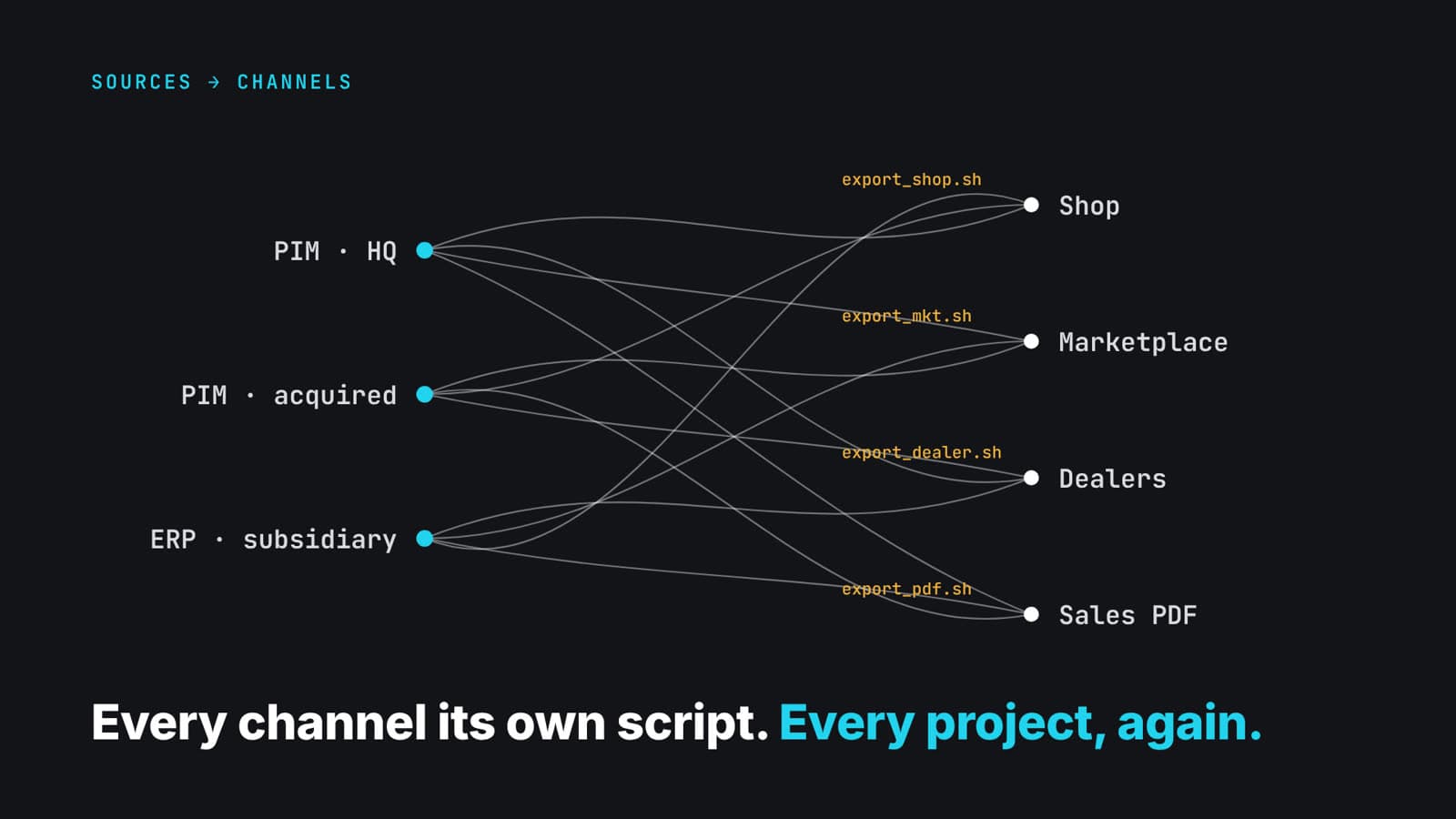
Every company runs a separate system for each task: an ERP such as SAP, a CRM such as Salesforce or Microsoft Dynamics, and for products a PIM that is often dated and has few interfaces, plus further product databases and media libraries. Something from each of these systems has to reach the website, the e-commerce shop or a campaign page, often per country and in several languages.
But the source systems rarely hold the data in every language and with all the content. Every connection needs developers to link each system, one by one. Project after project, the same work again.
It gets harder as a company grows. After an acquisition, there are suddenly two PIMs and two product catalogues. Subsidiaries in other countries develop and sell their own products, in their own systems and languages. Nobody has one view of the full range.
- The solution
In each project we built the same connections again. So avidia decided to build one system that closes this gap for good: PIM Gate.
With PIM Gate, the connections to your systems are built once. After that, PIM Gate delivers the data through standardised interfaces to websites, e-commerce shops, product data sheets, ETIM or your own AI systems. Everything gets simpler.
PIM Gate sits next to your PIM or ERP, not instead of it. It reads the data, checks it, decides who may see what and delivers it in the right format, language and channel. It is read-only by default; write-back is opt-in. PIM Gate grew out of one of these integration projects and runs in daily production today.
The goal is better product communication. PIM Gate optimises the data flow and delivers product data to every other channel through one central, well-documented interface. Every customer, supplier, sales rep and channel gets correct, current data, without anyone sending files by hand.

- How it works
Connect your sources
PIM Gate reads from your PIM or ERP via XML, REST or scheduled SFTP, each source on its own schedule. Everything lands in one open product schema with typed attributes, units, languages and markets. You can add further sources at any time: a second PIM after an acquisition, or the ERP of a subsidiary in another country. PIM Gate brings them together in one catalogue, in every language, and you manage it in one place.
Check every record at the gate
Before anything leaves, PIM Gate checks required fields, units, classification and the schema of each channel. Incomplete records are held back with a reason per field, so the gap is fixed at the source, not discovered by the customer.
Decide who sees what
Each portal, user and API token sees only what it is entitled to, by company, role, market, category or single asset. Filtering runs on the server. Every export is versioned and every action logged, so you can compare any two versions.
Deliver to every audience
Dealers and key accounts serve themselves in a branded Customer Portal with search, collections and bulk download. Shops, marketplaces and DXPs get data by API, webhook or scheduled feed, and delta sync sends only the fields that changed. Supplier and Sales Portals bring the same gate to supplier onboarding and customer-specific catalogues. Translation sends only new or changed text through your terminology and a human review step. PIM Gate keeps growing: further functions are already in development.
- What changes
- Customers and dealers find current data sheets and assets themselves, instead of waiting for an email
- Suppliers deliver structured data with live validation, instead of Excel files that someone retypes
- Sales builds customer-specific catalogues itself, scoped to each customer
- Acquired companies and subsidiaries with their own PIM or ERP join one central catalogue, in every language
- Each system is connected once; standardised interfaces then serve every website, shop and channel
- Delta sync sends only what changed: around 95% less payload than a full re-sync
- Every export is versioned and every action logged, ready for audits and new duties such as the Digital Product Passport
- Your PIM stays the source of truth, and your teams stop working as a mail service

“For 15 years we built the same bridge between PIM, ERP and CRM and the people who need their data, every time by hand. With PIM Gate we built it once, properly. PIM, ERP and CRM keep ownership of their data. We are the aggregator and the distributor: we bring the data together and deliver it to everyone who needs it.”